
Saddle fore/aft
Why we look at knee over pedal
Your hips are hard to judge by eye, but your knee and the pedal are easy to see. Slide the saddle back and your knee moves back with it. So where your knee sits over the pedal is a simple, repeatable read of where your hips sit.
Read it with the crank at the 3 o'clock position. At 3 o'clock the crank is level, and your push is near its strongest. A line dropped from the bony bump just below your kneecap should fall close to the pedal axle. That's a fitting tradition and a rough starting point for fore/aft, and it suits conventional road bikes best.
BFF Elite reads it as knee / pedal: the distance, front to back, from your knee joint to the pedal at the 3 o'clock position. A minus number means your knee is behind the pedal. The app measures from your knee joint, the same point it uses for your knee angle, not the front of your knee. Together with effective saddle angle, that shows where your hips, and with them your center of gravity, sit over the pedals.
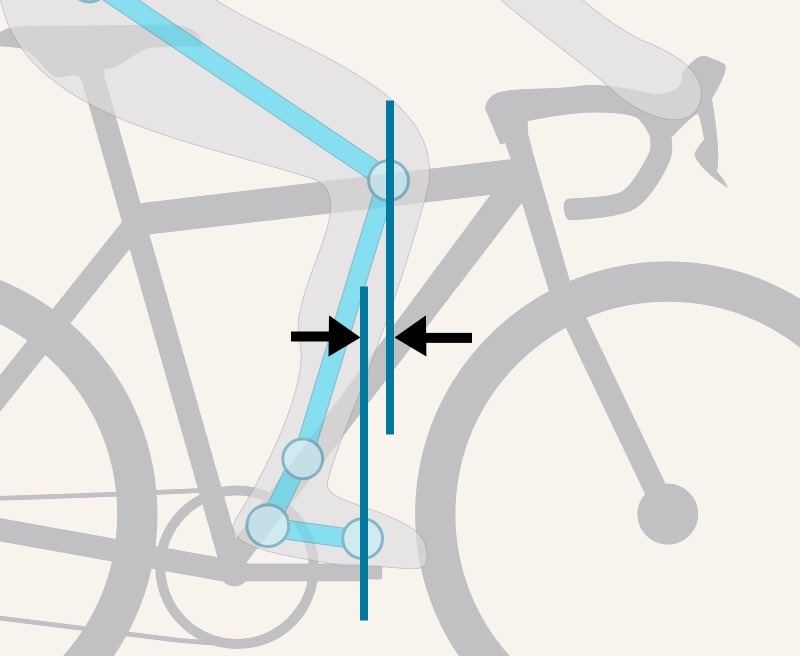
A small minus number is common and fine. In our data, road riders sit about 3 mm behind the pedal on average.
For your knee, saddle height is the main lever (Lesson 2). Fore/aft is about where your hips sit.
Go deeper: