 BFF Academy · EZ course
 Saddle height
What "correct" actually looks like: two angles
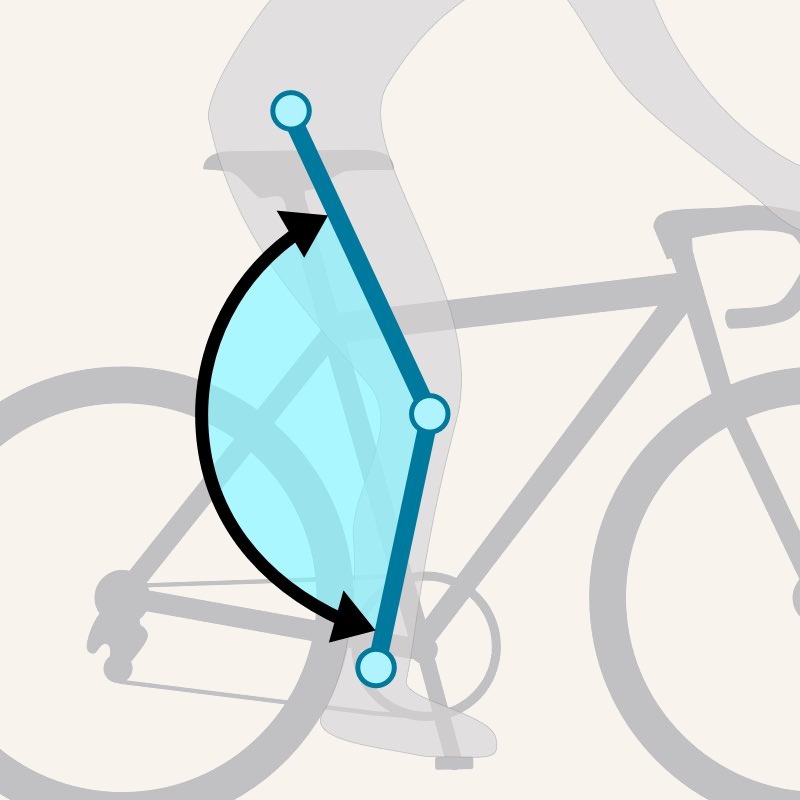
Your saddle is at the right height when two angles land inside reasonable ranges, both read at the point where your leg is most extended. That point is maximum knee extension (MKE), the moment in each pedal stroke when your leg is straightest, near the bottom of the stroke.
1. Knee angle at MKE. How straight your knee is at maximum extension, the hip-knee-ankle angle. Bike Fast Fit's fit windows are built on established bike-fitting standards and records of completed professional fits, with the target landing roughly in the 138 to 150° range. There's no single right value inside that, though: it shifts with your foot angle.
2. Foot angle at MKE. How your foot tilts at the same moment, heel-down (a low foot angle), toe-down (a high one), or somewhere between. It personalizes your knee angle target: a lower foot angle calls for a higher, straighter knee angle.
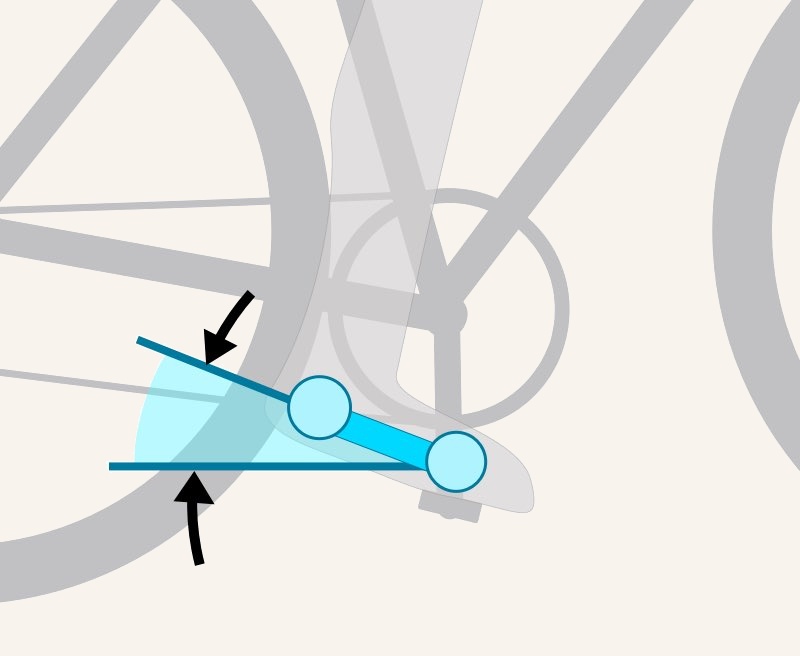
Why does a lower foot angle mean a straighter knee? Picture your foot as the last part of your leg reaching down to the pedal. Pointing your toes down, like rising onto tiptoe, extends that reach, so your knee can stay a little more bent. Dropping your heel pulls the reach back in, so your leg has to straighten more to get to the same pedal. Same saddle, different foot, different knee angle, which is why BFF EZ adapts the target to how you actually pedal.
Two riders have the same inseam. One pedals heel-down, one toe-down. At maximum knee extension, which is true?
Explain this
BFF EZ reads both your knee angle and your foot angle, then sets the knee angle target to match how you actually pedal, something a formula that looks only at inseam can't do.